![casmed [logo] H color 1 (1)](https://casmed.md/wp-content/uploads/2025/06/casmed-logo-H-color-1-1.png)

Social accountability in health does not begin with a definition. More often, it begins with a simple problem: someone points out what is not working, and an institution is willing to listen.
In a hospital in northern Moldova, several patients raised the same concern: meals were arriving cold in the wards. This was not a dramatic issue, nor did it involve expensive equipment or major reforms. Yet, for the people receiving care, it mattered deeply.
When you are ill, dependent on others, and facing trying days, the way your food is served ceases to be a minor detail. It is about comfort. It is about dignity. It is about the feeling that someone is looking after you.
The issue emerged during a participatory assessment of healthcare services. Patients completed questionnaires, sharing what worked well and what did not, and the findings were discussed with the hospital administration and staff. Following these discussions, the food distribution process was reviewed, and staff responsibilities were clarified. No major reform was required. What was needed was for patients to be asked for their opinions—and for those opinions to be taken seriously.
“We were pleased to see that our observations were taken into account. After the discussions, we noticed positive changes, and this made us feel that our opinions truly matter.” – Participant in the participatory assessment process
What does Social Accountability in Health mean?
Social accountability refers to the participation of citizens in monitoring and improving public services. In healthcare, it means that patients are seen not only as beneficiaries of medical services but as partners.
Patients can identify problems, provide feedback, and explain what is unclear, what discourages them, what makes them feel neglected, or what could be organized more effectively. Healthcare institutions can then use this information to improve their operations.
A healthcare system cannot be fully understood through reports and statistics alone. Numbers can show how many patients were treated, how many services were provided, or how much money was spent. However, they do not always reveal whether people felt heard, whether they understood the information they received, or whether they were treated with respect. Social accountability brings this missing element into the conversation: the patient’s voice.
Why does the patient’s voice matter?
Because a system that does not listen to people risks repeating the same mistakes.
Patients notice things that are sometimes invisible from behind an office desk: long waiting times, a lack of clear information, complicated procedures, barriers to access, poor communication, or issues regarding facility conditions.
Sometimes, solutions do not require significant investments; they simply require that a problem be acknowledged, discussed, and better organized. In other cases, patient feedback can help authorities identify where additional resources, clearer regulations, or management improvements are needed.
There is another vital benefit. When people see that their opinions matter, trust grows. In healthcare, trust is not a minor detail—it is an essential foundation of the relationship between patients and institutions.
The situation in the Republic of Moldova
The Republic of Moldova already has several mechanisms that enable citizens to participate in public life. People can request information of public interest, submit petitions and complaints, participate in public consultations, and demand explanations from authorities. National legislation explicitly provides for transparency in decision-making and dialogue between public institutions and civil society.
While these mechanisms exist on paper, they remain underutilized in practice. Many patients are not sufficiently aware of their rights, do not know where to report a problem, or lack confidence that their complaints will be examined. In some cases, institutions themselves lack simple tools to collect feedback and translate it into concrete actions.
As a result, a vicious cycle emerges: people do not speak up because they do not believe they will be heard, and institutions rarely implement changes because they do not receive clear, structured feedback. Social accountability seeks to break this cycle.
A simple tool: The Community Score Card
Over the past five years, several initiatives in the Republic of Moldova have demonstrated that dialogue between patients and healthcare institutions can lead to meaningful change.
One example is the project “Towards Health Equity through Social Accountability”, implemented by the Swiss Red Cross in partnership with the local NGOs “CASMED” and “HOMECARE” under the framework of the programme “Progressing towards Universal Health Coverage in Moldova”, with financial support of the Swiss Government (SDC).
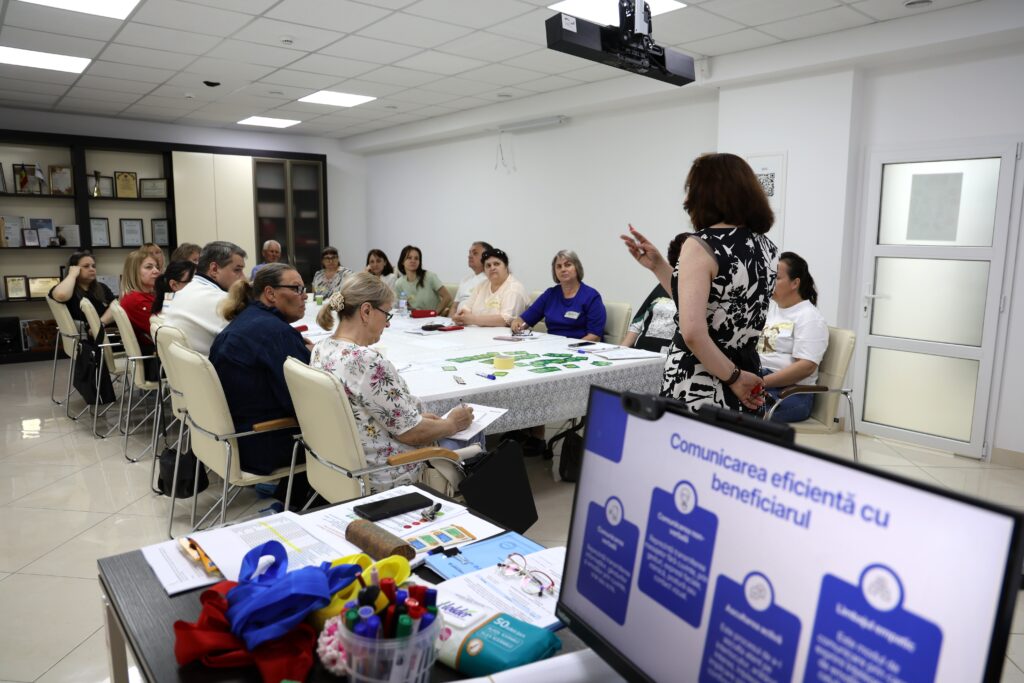
Through this project, mechanisms for dialogue were established between patients, healthcare institutions, and public authorities. One of the most important tools used was the Community Score Card (CSC), a participatory method for evaluating healthcare services.
How does it work? Patients assess healthcare services, identifying what works well and what does not. The results are discussed with representatives of the healthcare institution, and concrete actions are then agreed upon. The method is not complicated, yet its strength lies in its simplicity: it bridges patients’ real-world experiences with the institution’s capacity to drive change.
What results have been achieved?
The results speak for themselves. Across the six participating healthcare institutions, patient satisfaction increased from 30.4% to 86% over a three-year period.
The tool has also gained national recognition. Through Order No. 380 of the Ministry of Health, issued on April 16, 2024, participatory assessment was officially incorporated into the Practical Guide for Assessing Patient and Employee Satisfaction in the Healthcare System.
This is a major milestone. However, the true value of this approach lies not only in official orders or statistics—it lies in the small but meaningful improvements that patients experience first-hand when they enter a healthcare facility.
What does this experience show?
Social accountability does not promise to solve all the problems of the healthcare system. It cannot replace adequate financing, robust management, or structural reforms. What it does, however, is something that public systems too often forget: it places people at the centre of the discussion.
A patient who is asked the right questions can provide essential insights. An institution that listens can optimize its processes. An authority that monitors these changes can gain a better understanding of reality on the ground.
Healthcare systems do not change through regulations, budgets, and strategies alone. They also change when patients are asked, listened to, and taken seriously.
References:
- Declarația de la Alma-Ata, Organizația Mondială a Sănătății (1978).
- The Five-Point Call to Action for Measurement and Accountability in Health.
- Making fair choices on the path to universal health coverage
- Ghid privind responsabilizarea socială
- Ghid Practic
Author: Livia Golovatîi, Project Coordinator, CASMED NGO.